Three questions a round. Nothing shown until five or more people answer. Research never mixed with your figures. Illustrative.
The project you get to skip
Know how work is landing. Without becoming a survey expert.
Measuring wellbeing normally hands HR a project: decide what to measure, write or buy the questions, schedule the rounds, chase the responses, then work out what the numbers mean. Most tools help with the last step and leave the rest where it fell.
None of that is your job here.
What the Engine handles
The Engine does the measurement work.
First time
Everyone answers all nine questions once, so there is a baseline.
Then
Three questions every fortnight, under a minute. The same two every time; one rotates through the other seven.
Optional, always
Two further sections, about the person and their health, sit behind their own consent tick. Everyone answers as much or as little as they like.
manage.alltoogether.com · wellbeing · what we measure
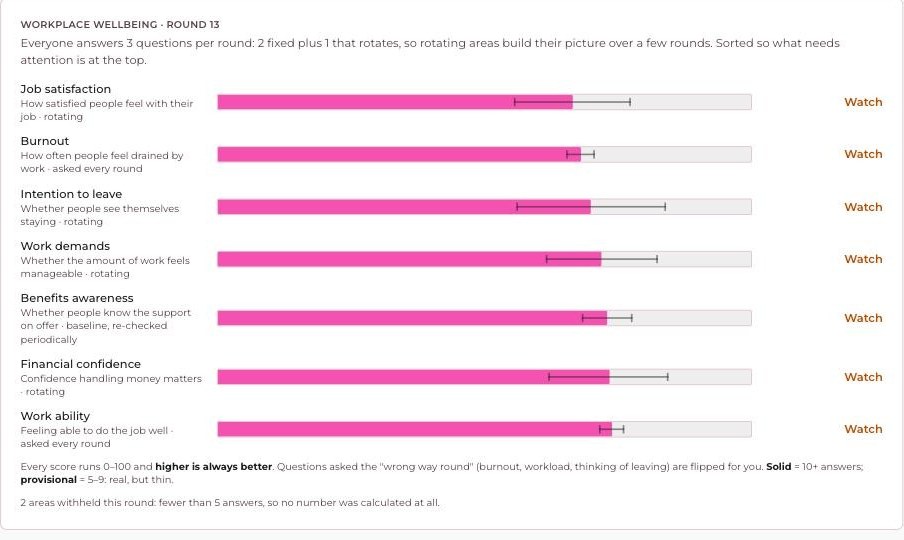
Live capture, demonstration organisation. Every measure is named, scored with the range it could sit in, and flagged when it needs attention.
The Engine selects the questions from established research. Nobody in HR writes, picks or schedules them. They cover the parts of work that tend to show up later in burnout, absence and people leaving.
What you see
You see the shape. Never the person.
Results only ever appear as averages of five or more people. There is no individual view, no team view, no department view and no manager view - the employer picture is the whole organisation, and that is the design, not a missing feature. The five-person floor is enforced in the database, not a setting: below five, no number is calculated at all.
Small groups are labelled as indicative rather than presented as certainty.
manage.alltoogether.com · wellbeing · overview
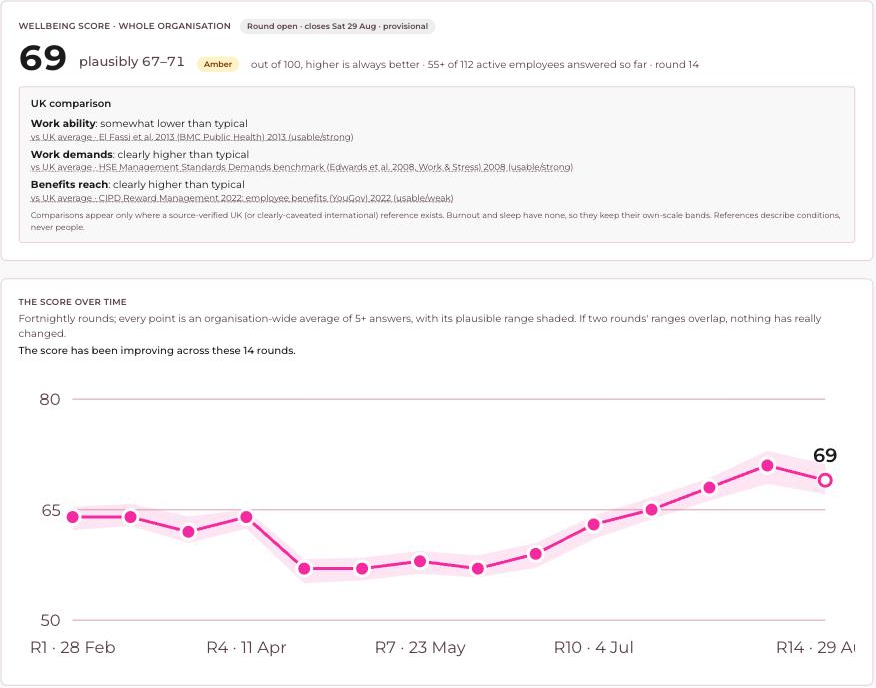
Live capture, demonstration organisation. The score comes with the range it could sit in, comparisons carry their sources, and every point is an average of five or more people.
manage.alltoogether.com · wellbeing
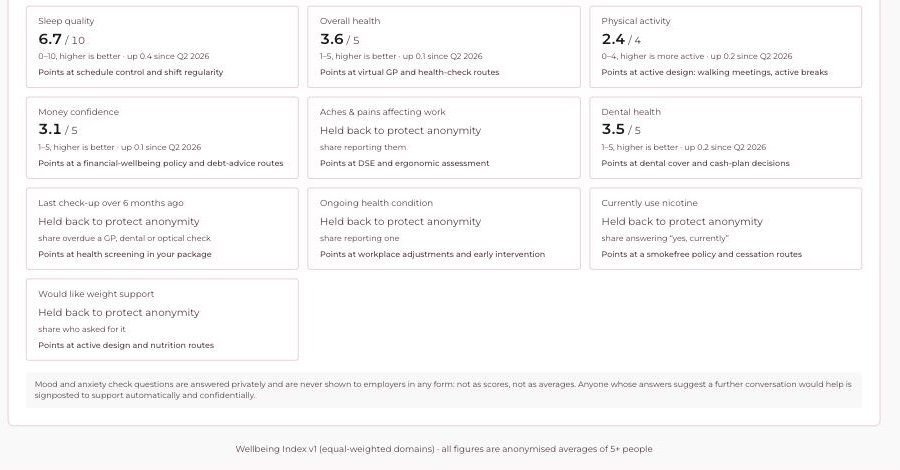
Live capture, demonstration organisation. Below five, nothing is shown.
Support
Support that never watches back.
Crisis and safety signposting appears on every employee screen and is the same for everyone.
Where someone's answers suggest they may benefit from support, the Engine can privately offer them a relevant next step. Their employer never sees what they answered, whether a next step was offered, or whether it was taken.
Employers can also put the support already inside their schemes - an EAP, virtual GP or physio route, for example - on a page people can reach without logging in.
Getting started
From signup to first picture.
Create your workspace - a couple of minutes, no card.
Add your people - type them in, upload a CSV, or share a join link; there is a print-ready QR poster for anyone not at a desk.
Send the first check-in - everyone answers all nine questions once, so there is a baseline. The check-in reaches people by email or in Google Chat, with a shareable web link too. Slack and Teams are coming.
Your first picture arrives as soon as five people have answered.
Under the hood
The measurement approach, the anonymity floor, the small-number rules and what we refuse to claim are all written down.
Broking is our funding model; the IWE is free and is not conditional on any insurance purchase. If you want to see what the broking side looks like across the year, that story lives on its own page: How we work →
Questions
Two questions worth answering plainly.
What is the Intelligent Wellbeing Engine?
The Intelligent Wellbeing Engine is a free, anonymous wellbeing check-in for UK employers, built by Alltoogether, a UK employee-benefits broker and workplace-health platform. The first time, everyone answers nine questions about work and wellbeing, so there is a baseline. After that it is three questions every fortnight, under a minute, from the same set of nine. Employers see how the organisation is doing, as anonymous organisation-wide averages of five or more people. Everyone sees crisis and safety signposting on every screen, the same for every person. Where someone's answers suggest they may benefit from support, the Engine can privately offer them a relevant next step - their employer never sees what they answered or where they went.
Is it a clinical or medical assessment?
No. The Intelligent Wellbeing Engine is a non-clinical wellbeing check-in. It is not a medical or clinical assessment. Crisis and safety signposting, including Samaritans and Mind, appears on every screen and is the same for everyone.
See how your organisation is doing. Free, and open now.
No card, no questions to write, no sales call. Your first picture arrives as soon as five people have answered.