Story starters
Angles, not articles. We have not written these up, so the story is yours. No employer is named for what it leaves out, and we would ask you not to single one out from a careers page alone.
We found nothing about staff benefits on most company websites
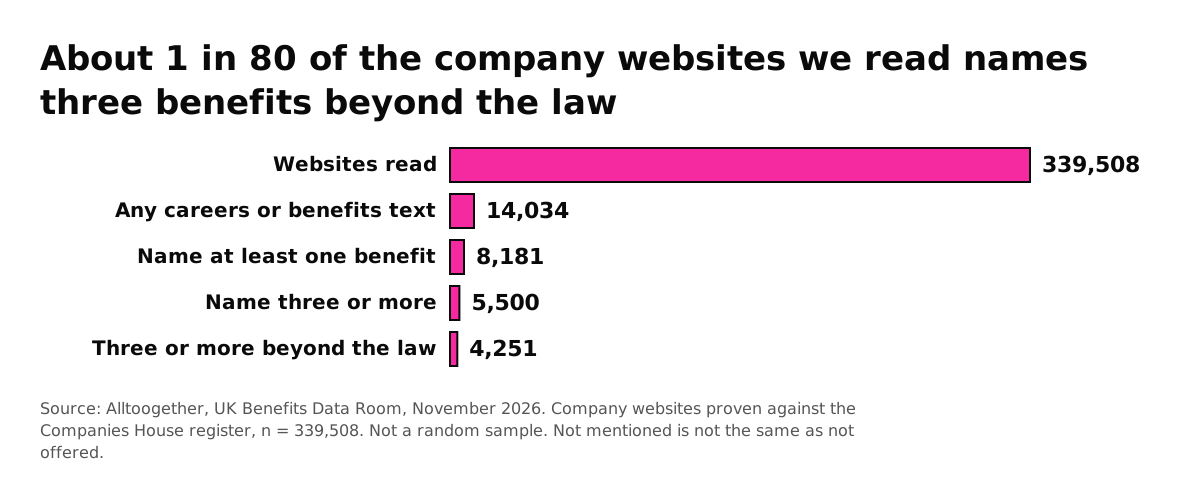
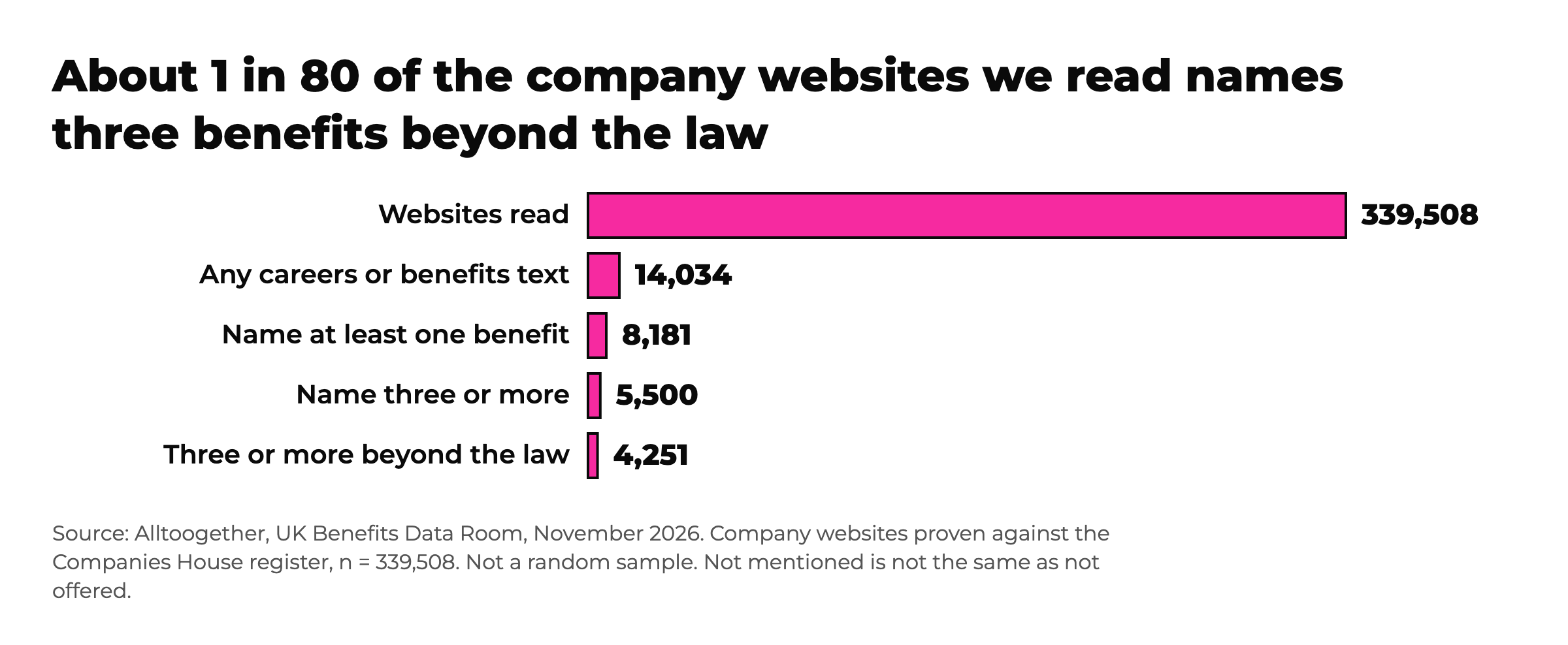
We read 339,508 websites we could prove belonged to UK companies. We found careers or benefits text on 14,034, 8,181 named a benefit and 5,500 named three or more. Take out what the law requires and 4,251 remain, about 1 in 80.
Before you run it: We read each homepage and its careers, jobs and benefits pages, and a site built in JavaScript can read as empty. Many small firms are not hiring, and a company may describe benefits on a job board or LinkedIn, which this count leaves out. Not mentioned is not the same as not offered.
Suits: National and business desks
"Company pension" and no number
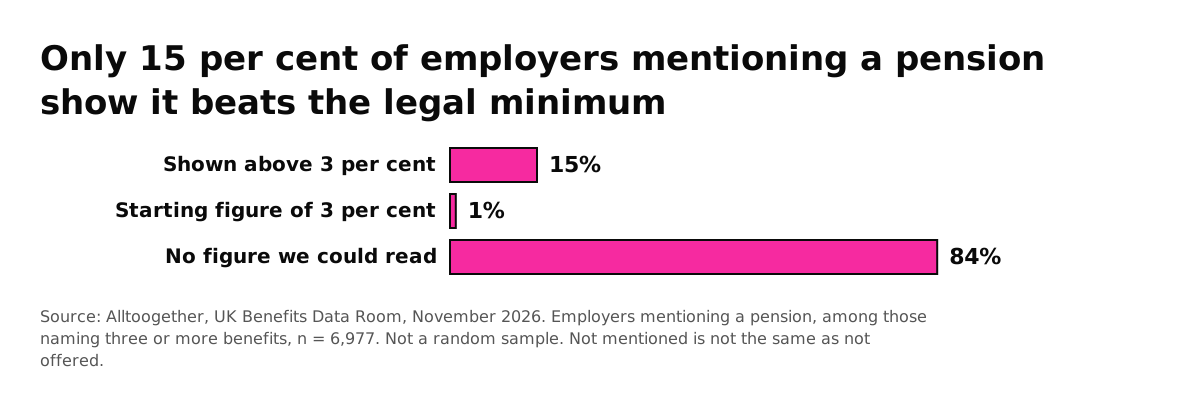
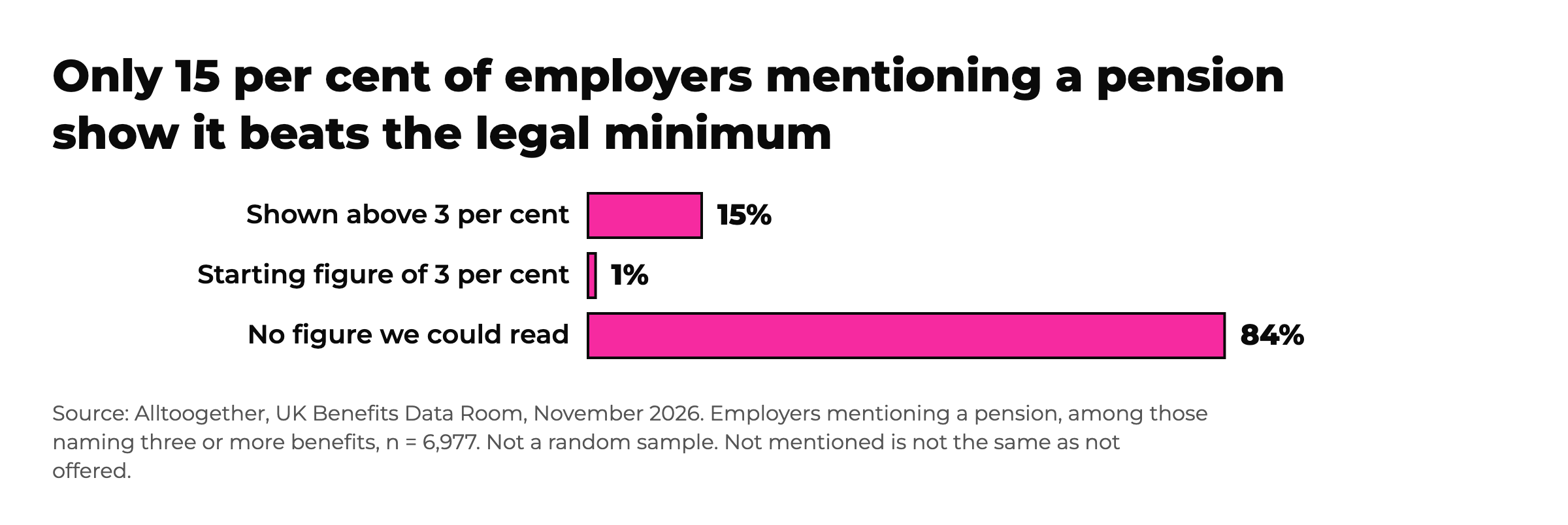
72 per cent of the 9,682 employers naming three or more benefits mention a pension. 15 per cent of those show it beats the legal minimum, and 84 per cent give no figure we could read. The median stated is 6 per cent, counting "up to" rates at their maximum. 235 state 10 per cent or more, and 112 of those are "up to" maximums.
Before you run it: Software read these figures, and about 134 pension lines quote a rate above 3 per cent that it could not place, so treat 15 per cent as approximate. Most employers giving no figure may well pay more than the minimum. The data show what they say, not what they pay. Not mentioned is not the same as not offered.
Suits: Pensions and reward press
The job advert dictionary
Employers that call their holiday "generous" somewhere on the pages we read give the days about 4 times in 10 (552 of 1,375), against about 6 times in 10 for others (3,770 of 6,324). In sentences that do give a figure, the median is 25 days with or without the word. "Generous" pensions, where stated, do run higher: a median of 10 per cent against 6.
Before you run it: The holiday comparison is measured line by line across the pages we read, so treat it as approximate. Pension figures with the word "generous" are few (90). Not mentioned is not the same as not offered.
Suits: HR and reward press
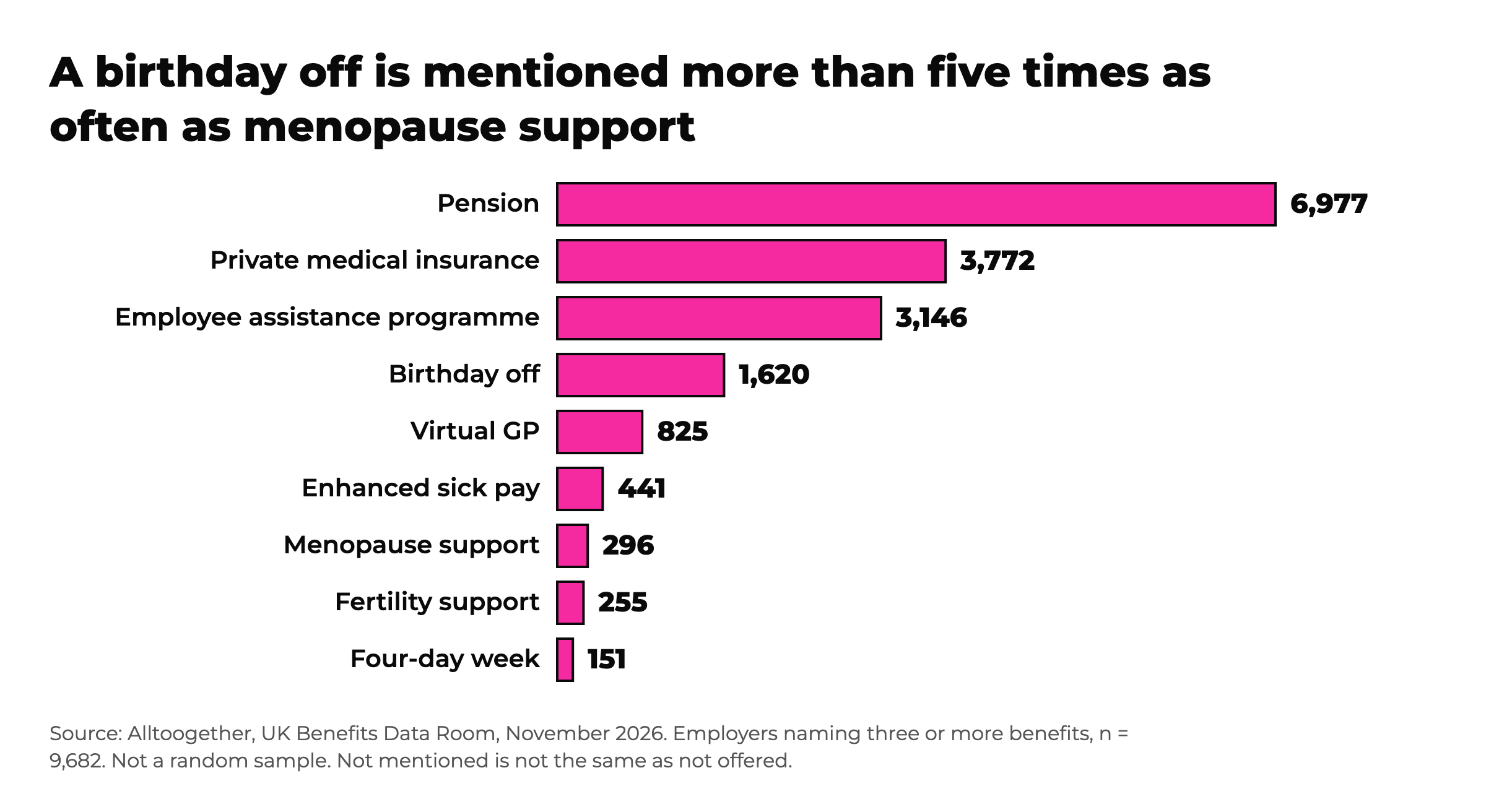
A birthday off is mentioned more than menopause support
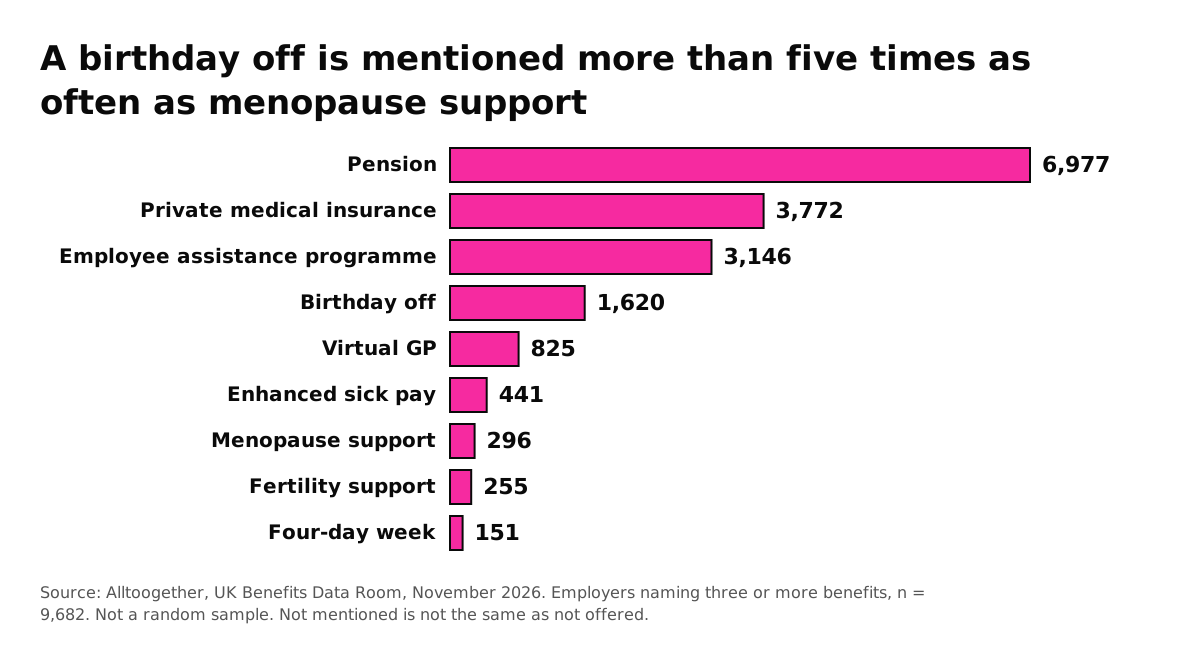
1,620 employers mention a birthday off, 296 mention menopause support, 255 fertility support and 151 a four-day week or nine-day fortnight.
Before you run it: Mentions undercount what is on offer. Employers with a menopause policy may not list it on a careers page. Not mentioned is not the same as not offered.
Suits: HR titles and national features
The virtual GP few employers mention
3,772 employers advertise private medical insurance. 91 per cent never mention the virtual GP that usually comes with it, and 12 per cent say who provides the cover. Where an employer names an insurer whose cover usually includes the service, 88 per cent never mention physiotherapy (662 employers) and 97 per cent never mention second medical opinions (222).
Before you run it: 5 of the 7 insurers we audited in August 2026 confirm a virtual GP. What a scheme includes depends on the policy. Not mentioned is not the same as not offered.
Suits: Insurance and protection press
Parental leave, rarely in weeks
2,804 employers mention parental leave. 66 per cent call it enhanced or similar, or give weeks at full pay, and 10 per cent give the weeks. The median stated is 20 weeks.
Before you run it: Weeks at full pay only, from 281 stated figures. Some pages give the figure for one type of parent. Not mentioned is not the same as not offered.
Suits: HR titles and family policy writers
Which sectors put the number down
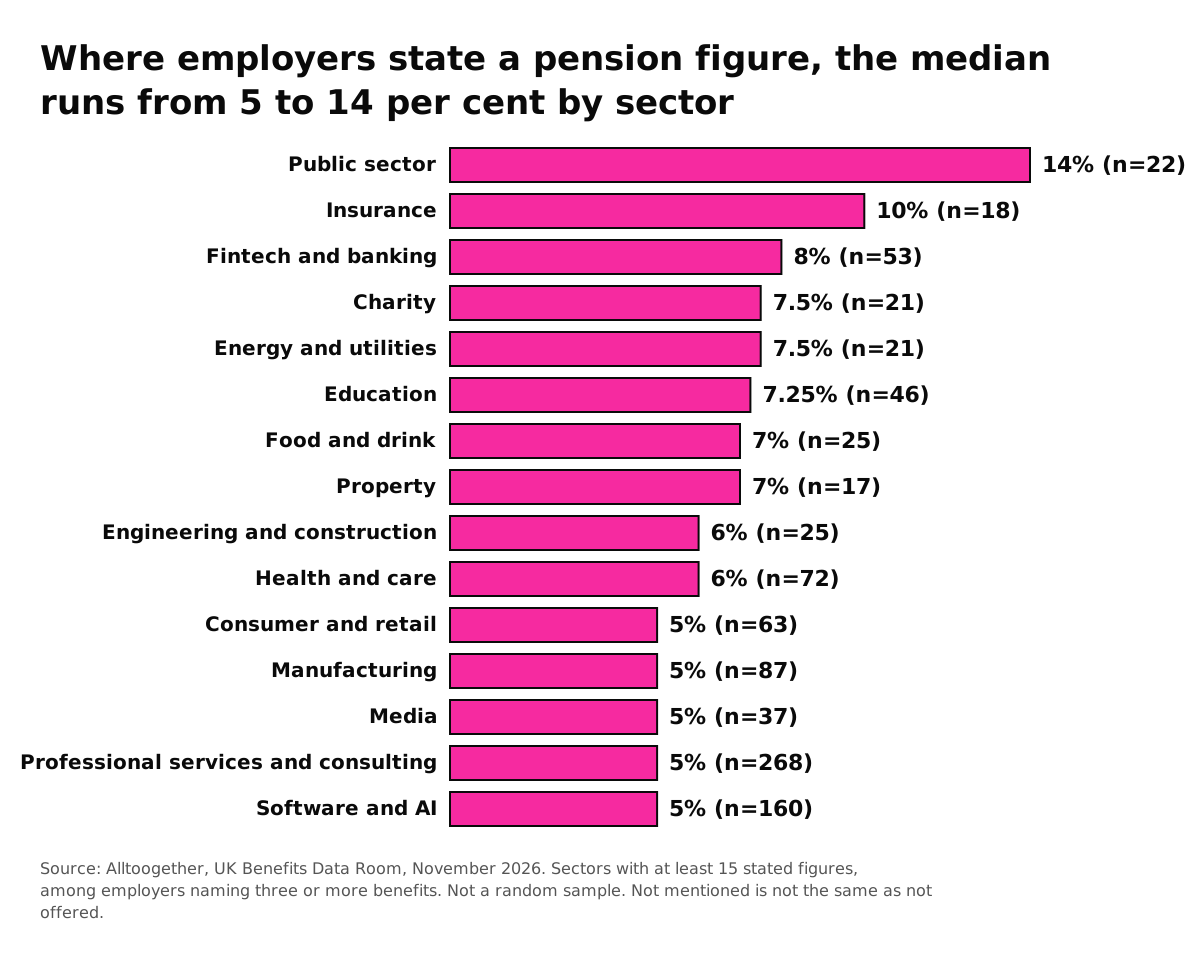
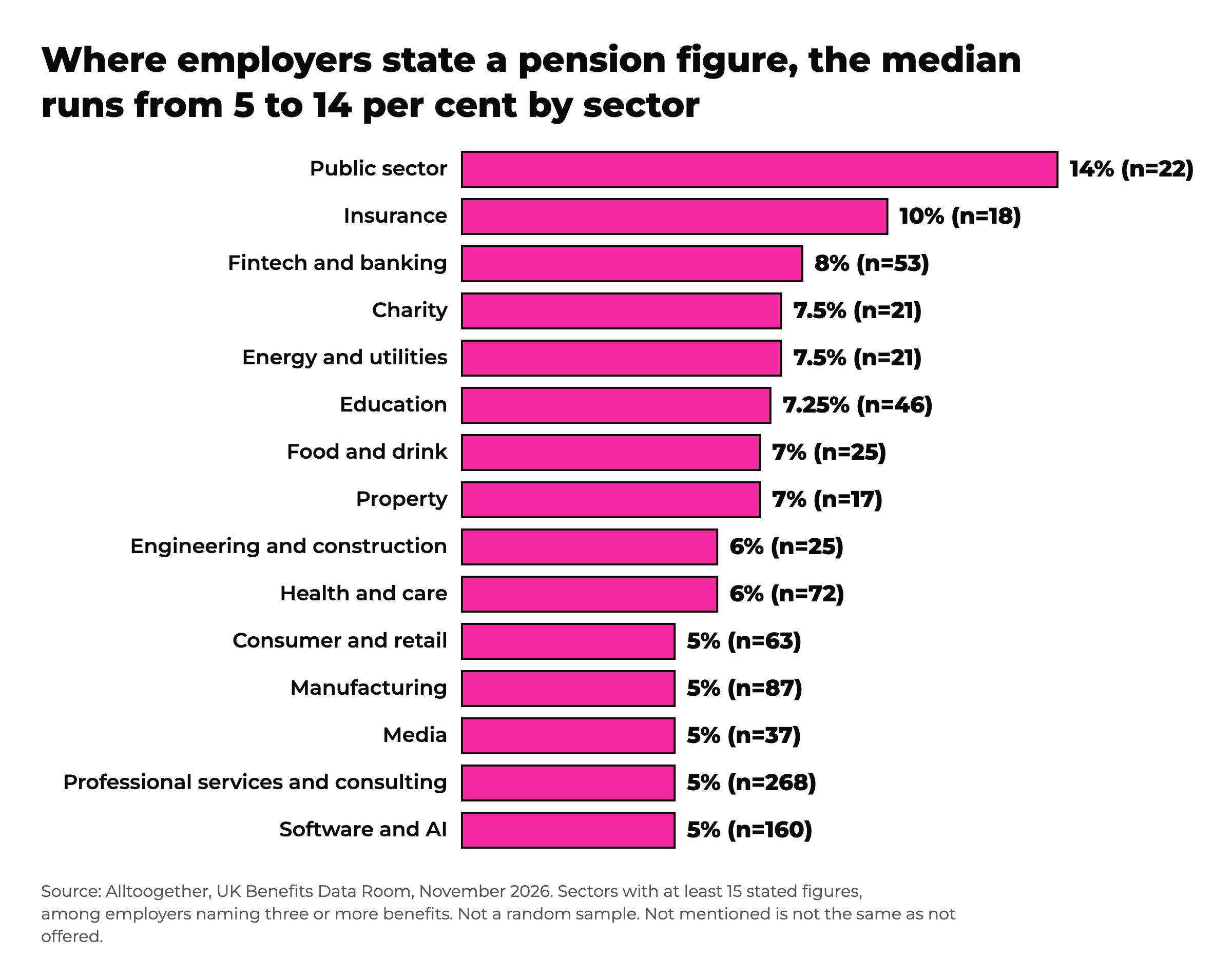
Median stated pension is 14 per cent in the public sector and 5 per cent in 5 sectors, including software and AI. Median stated holiday is 27 days in the public sector and 25 days in every other sector. Pick any sector in the table below.
Before you run it: Medians come only from employers that state a figure, who may not be typical of their sector. Sectors come from an employer's trade codes and name, so some are approximate. Not mentioned is not the same as not offered.
Suits: Sector trade press
Your region
Every UK region sits between 1.1 and 1.5 per cent of company websites naming three benefits beyond the law. The North West, where we are based, is at 1.3 per cent. The gap between regions is small.
Before you run it: Region comes from the registered office, which is not always where staff work. A few postcode areas straddle borders. Not mentioned is not the same as not offered.
Suits: Regional business desks
The Top 50 most open employers
777 employers state both a pension and a holiday figure above the legal minimum. The Top 50 below give the most figures. Each links to its page, with the employer's own words.
Before you run it: This ranks how much an employer tells people, not how good its package is, and it is built from pages as we read them. Not mentioned is not the same as not offered.
Suits: HR titles, regional desks and the employers themselves
The Top 50 most open employers
These employers give people the most figures on their own pages. To qualify, an employer must state both a pension and a holiday figure above the legal minimum. It then ranks by how many benefits it gives a figure for, then by how many it names. Two AI review sessions read every cell against its quote, and we removed recruiters, job boards, sales pages and misread pages. Many employers tie at three figures, so the last places are close.
This measures openness, not the quality of a package. Figures are as read on the employer's page between 13 October 2026 and 21 October 2026, and each name links to its own words. Employers appear because their pages are public, not because they work with us.
Holiday is before bank holidays unless marked "as stated". Pension is the contribution as the page states it, and "up to" means a maximum. Parental leave is the weeks at full pay the page states, which can be for one type of parent. A dash means no figure we could read. Not mentioned is not the same as not offered. Find any employer.
How we got the figures
Where the data come from. We checked 4,013,464 companies on the Companies House register. We accepted a website only if it showed the registered company number, or the full name with the registered postcode, which gave 341,334 websites, 8.5 per cent of those checked. We could read 339,508 of them, looking at the homepage and any careers, jobs and benefits pages. A site built in JavaScript can read as empty. We also read the careers pages and job adverts of employers from gender pay gap lists, public job boards and our own company lists. All reading took place between 13 October 2026 and 21 October 2026.
What counts. Software rules look for 39 benefits in each employer's own words, and every fact keeps its sentence and link. What the law requires is not counted as a benefit: a 3 per cent employer pension contribution, 5.6 weeks' holiday and statutory parental pay. For the website figures, a pension or holiday must show a figure above that floor, and parental leave must give weeks at full pay or be described as enhanced or similar. For an employer to have a public page, three benefits are enough, even if a pension has no figure, and the page says what is missing. That is why 9,682 employers have pages and 8,069 of them clear the stricter test.
How it was checked. Before each release an AI review session reads a random sample of facts against their quotes. The latest round, on 3 November 2026, found 2 of 50 wrong, and we queue each mistake for a rule fix. The report's limits section lists each round.
What it cannot tell you. Not mentioned is not the same as not offered. These figures show what employers say in public, not what they provide, and mention shares probably understate provision. The employers are the ones whose pages we could read, with larger employers and those with careers sites over-represented, so this is not a random sample and not an estimate for all UK employers. The 95 per cent intervals in the tables describe these counts only. Employers can correct their own pages, and any figure an employer sends us is marked as confirmed by that employer. Differences between groups are associations, not causes.
Contains public sector information licensed under the Open Government Licence v3.0. Insurer services come from our audit of insurer websites, August 2026. This is research, not advice on any insurer or product.