The rules it follows, including the ones that make the numbers look worse.
Written for whoever has to explain this to their people, not for statisticians. Every answer starts plainly; the detail sits underneath it if you want it.
The short version
Two jobs, one piece of measurement.
The Intelligent Wellbeing Engine gives an employer an organisation-wide picture of the conditions around work, the kind that tend to show up later in absence and people leaving. And where an employer has set up the support available to its people, it can privately offer someone a relevant next step when their answers suggest it may be useful.
Everything on this page is about how we do that without anyone becoming a data point for their manager.
Question 1
What does it actually ask?
Nine questions the first time, so there is something to measure against. After that, three questions every fortnight, which takes most people under a minute.
The questions come from established research rather than being written by us or by your HR team. The Engine selects which ones to ask and when. Nobody has to design a survey, schedule a round or chase responses.
The detail: two of the three rotate in and out, so a person answers across the whole set over several months rather than the same three each time. It is non-clinical. It is not a medical assessment and it is not a substitute for professional care.
Question 2
Who sees what?
The employer sees the organisation. One picture, for everybody, with no way to narrow it down.
The person keeps their answers. What they said is not shown to their employer, at any point, in any view.
What an employer never sees
An individual answer, or an individual result.
A team, department or manager breakdown.
A list of who took part and who did not.
The detail: those views do not exist to be switched on. There is no individual score anywhere in the product, and no completion lists are kept, so non-participation is invisible too.
Question 3
What happens if only a few people answer?
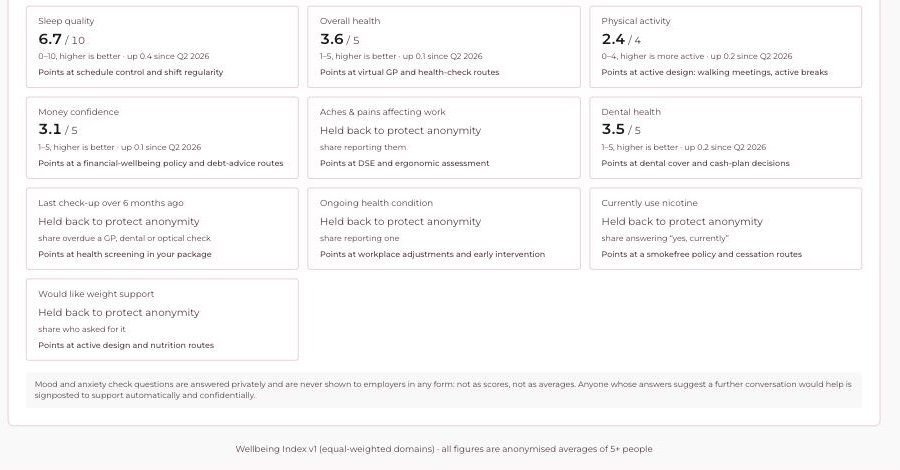
Below five answers you see nothing at all. Not a blurred figure, not a rough guess. Nothing, with a note saying why. Five or more and a result appears.
We would rather show you an honest gap than a number that quietly puts somebody at risk of being worked out.
manage.alltoogether.com · wellbeing
Live capture, demonstration organisation. Five signals scored, five withheld: the floor doing its job.
The detail: the rule is a constraint in the database itself rather than a setting in the software, so it applies to every route by which a result could be produced, including our own internal processes. Nobody at your organisation or ours can turn it off. Measures dealing with severe distress use a higher floor again.
Question 4
Does five people mean it is anonymous?
Five is a reporting threshold. We state it in advance, we apply it everywhere, and we cannot turn it off. It is not a mathematical guarantee that nobody could ever be identified in any possible workplace, and we would rather say so than let you assume otherwise.
In a very small organisation, where somebody knows exactly who was asked, a threshold is protection rather than a promise. That is worth knowing before you tell your people anything.
Question 5
Seven answers is not seventy.
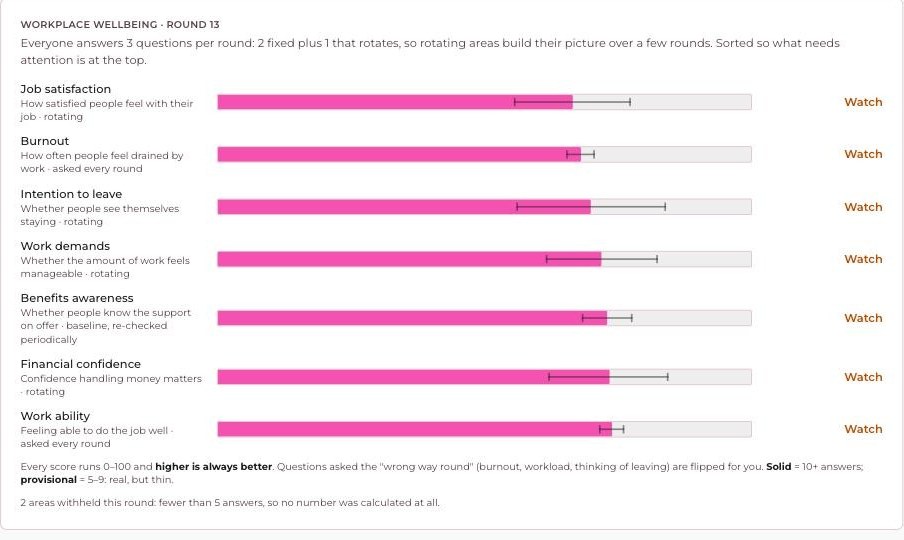
When a result rests on a small number of answers, we label it as provisional and show the range the true figure could sit in, rather than one confident-looking number.
It looks less impressive in a demonstration. In front of a board asking how you know, it is the part that makes the number useful.
manage.alltoogether.com · wellbeing · what we measure
Live capture, demonstration organisation. Every measure is named, scored with the range it could sit in, and flagged when it needs attention.
The detail: results from five to nine answers are marked provisional. From ten upwards they are presented with more confidence, still with their range. We round counts rather than publishing exact ones, because an exact count is one of the easier things to reason backwards from.
Question 6
Do you compare us to other organisations?
Only where a reliable comparison exists and we can tell you exactly where it came from. Where one does not, the dashboard says so rather than inventing something for the sake of a benchmark.
manage.alltoogether.com · wellbeing · detailed
Live capture, demonstration organisation. Each comparison names the study it came from.
The detail: no single organisation is allowed to make up a large share of any comparison group, and a comparison group has to reach a minimum size before it is used at all. Otherwise the benchmark is quietly telling you about one company rather than a sector.
Question 7
What else stops somebody being worked out?
The five-person rule on its own is not enough, because people are clever with arithmetic. Four further rules sit behind it, and they only ever hide more, never less.
When your headcount moves
If people join or leave between rounds, we pause that result for a cycle rather than let somebody compare before and after and work out what the new person said.
When nearly everyone answered
If a small group is almost fully accounted for, we roll the result up to a wider group instead of publishing it. A near-complete set is easier to reason back from than a partial one.
How many ways you can slice
There is a cap on how finely a result can be cut, and the floor applies to any figure that could be worked out from the ones shown, not only to the ones on the screen.
Rounding
Counts are published in bands rather than exactly, and averages are rounded more heavily when they rest on fewer answers.
Question 8
What do you refuse to claim?
This is the section most measurement products do not have, so it is worth reading.
That it predicts or reduces absence, staff turnover, claims or insurance premiums. It measures conditions; what happens next is your organisation's work, not a number's.
That it identifies who is unwell, or who is at risk. It produces no individual result at all.
That it makes you compliant with anything. It can be evidence that you are managing something. Evidence is not an outcome.
That anything is certified. Our approach is aligned to ISO 45003 guidance, and guidance is not a certificate. We will not pretend otherwise.
Question 9
What happens to the data?
Individual answers are held in pseudonymised form and deleted, or turned permanently into aggregates, twelve months after they are given. The organisation-wide results are kept, because they are the thing you are using.
Two promises worth stating plainly. We never use anybody's answers to market or sell to them or to their employer. And no answer anybody gives is ever used to underwrite or price insurance, which matters because we are also a broker.
The detail: data is hosted in the EU. A data protection impact assessment covers this processing and is reviewed on any material change. Participation is voluntary, and stopping is as simple as ignoring the next check-in.
Question 10
Who decided all of this?
We did, and we have written the decisions down and dated them rather than leaving them to memory. The rules above are not aspirations; they are positions the company has adopted, and most of them are enforced by the software rather than by anyone remembering.
Alltoogether was founded by Zak Fenton, who spent twenty years in employee benefits and then took an MSc in Workplace Health and Wellbeing at the University of Nottingham. Where our approach draws on public frameworks, those are named: the HSE Management Standards for psychosocial risk, ONS definitions for absence, and ISO 45003 as guidance we align to.
Last reviewed: 24 August 2026.
Ask us something harder.
If something on this page does not add up, we would rather hear it. Journalists, occupational health teams and anyone about to explain this to their workforce are all welcome to push on it.